

Why two “frameless shower doors” can land at totally different prices in 2026
If you’ve gotten a couple quotes and thought, “How is this that far apart,” you’re not crazy.
“Frameless glass” isn’t a single product with a fixed price tag. It’s more like ordering a custom suit. Same general category, but the final number depends on what you’re actually building and what it takes to install it cleanly.
In 2026, your price usually comes down to a handful of real variables:
- Design (unit type): a simple swing door is one thing. Add a fixed panel, returns, angles, sliders, transoms, and the parts and labor change fast.
- How much glass: bigger and taller means more material, more weight, and usually more handling on install day.
- Glass and finish choices: clear vs ultra-clear (low-iron), thickness options, frosted/patterns, grid looks, digital ceramic printing.
- Hardware: standard finishes vs special-order colors, plus any upgraded handles, towel bars, robe hooks, etc.
- Install reality: condos, stairs, tight access, tricky tile, out-of-plumb walls. This is the “hidden” driver people don’t think about until the installer shows up.
The good news: once you understand these levers, you can control the outcome. You can decide where you want to spend for the look and feel you want, and where to keep it simple to stay efficient.
Next up, we’ll start with the biggest lever of all: the unit type you choose.
The biggest things that move your price (the quick checklist)
If you only remember one thing, make it this: your quote isn’t random. It’s the result of a few levers that either keep the job simple and efficient, or push it into “custom build with extra parts, time, and risk.”
Here’s the short list of what most influences your frameless shower door price in 2026:
- Unit type (design): door only vs door + fixed panel, returns, neo-angle, sliders, steam, transoms. More pieces and connection points usually means a bigger jump than people expect.
- Overall size: total glass square footage, height, and panel widths. Bigger glass is heavier and harder to handle, and that shows up in both material and labor.
- Glass choice: clear vs low-iron (ultra-clear), thickness options, frosted/patterned glass. Upgrades here are legit, but they’re still upgrades.
- Custom looks: grid-style glass or custom etching. These add specialty processing and longer lead times.
- Protective coating (EnduroShield): optional, but it’s a real add-on with a real cost. For the right house, it’s a “pay once, clean easier” move.
- Hardware finish: standard finishes vs special-order colors. Special finishes can mean upcharges and longer lead times, and everything has to match.
- Add-ons: towel bars, robe hooks, upgraded handles, headers, clips, and other extras. Individually small, collectively not small.
- Logistics and site conditions: condos, stairs, long carries, limited parking, narrow work windows, tricky tile conditions. This is where labor and planning can climb.
Everything else is usually a smaller ripple compared to those.
Next, we’ll start breaking these down one by one, beginning with the biggest lever: your unit type.

Your shower “style” is usually the biggest price driver (and what each one tends to cost in 2026)
When people say “frameless shower door,” they’re describing a whole category. The actual layout you choose is what usually sets the base tier of the project. More glass pieces, more hardware, more alignment work. That’s where the price moves.
Here are the most common frameless setups and the kind of broad 2026 ballparks homeowners typically see for a straightforward install with standard finishes. Your exact quote can land outside these depending on size, glass upgrades, hardware finish, and jobsite logistics (we’ll get to those).
Fixed panel only (splash panel / stationary glass)
- Clean, modern walk-in look. One piece of glass, minimal hardware.
- Often lands in the high hundreds to low $1Ks.
- Goes up when it’s extra wide/tall or needs additional stabilization.
Door-only (single swing door between two walls)
- The simplest “true frameless door” setup.
- Often lands around the low $1Ks into the mid $1Ks.
- Taller doors, wider doors, thicker glass, or upgraded hardware push it up.
Inline unit (swing door + one fixed panel in a straight line)
- Super common when the opening is wider, or you want a specific door width.
- Often lands in the mid $1Ks into the low $2Ks.
- The jump is normal because you’re adding another panel of glass plus more mounting/support.
Corner unit (90-degree door + panel)
- Great look, very common, but corners demand more precision.
- Often lands in the upper $1Ks into the mid $2Ks.
- Bigger/taller glass and out-of-plumb walls can move this into a higher tier.
Neo-angle (angled shower, usually three pieces)
- If your shower has angles, it usually means more seams and more complexity.
- Often lands around the $2K range and up.
- This style tends to climb faster than straight units as size and height increase.
Sliders (byVirtual Showroom Bypass Sliderspass / barn-style family)
- Ideal when you don’t have room for a door to swing.
- Big range: from under $1k for prefab units, into the $2Ks, sometimes higher.
- The hardware system matters a lot here, and custom sizing tends to land higher than stock.
Premium slider systems (heavier-duty, “high-end glide” style)
- Smoother feel, heavier hardware, tighter tolerances.
- Typically lives in the higher end of the $2Ks and up depending on size and options.
Steam showers, transoms, multi-panel “all glass” builds
- More glass, more details, more planning.
- Typically starts in the mid-to-high $2Ks and can go well beyond depending on layout.
The quick takeaway: if you want to keep the price efficient, keep the layout efficient. Fewer panels, fewer angles, fewer special features. If you want the more custom look, totally doable, just know the quote is following the build.
Next section: size, and why “just a little bigger” can turn into “a lot heavier and a lot more work.”

Your size: why “just a little bigger” can change the price more than you’d think
After unit type, the next biggest driver is simply how much glass you’re buying and handling. With frameless, size isn’t just “a wider opening.” It’s more like: square footage + height + weight + how hard it is to safely move and set the panels.
Here’s what “size” really means in a frameless quote:
Total glass area (square footage)
More glass is more material, more polishing/finishing work, more time. Even a modest bump in width or height can add a meaningful amount of glass across a door plus one or two panels.
Height changes everything
Going taller often moves the project into a different feel and sometimes a different hardware approach. Taller glass is:
- heavier to transport and carry into the bathroom
- more awkward to set safely
- more sensitive to walls that aren’t perfectly plumb
That’s why a “same design, but taller” shower can jump more than people expect.
Door size specifically matters more than panel size
A fixed panel is straightforward. A door has moving parts. Wider or taller doors may need:
- heavier-duty hinges
- different handle options
- tighter tolerances so it swings cleanly without rubbing or drifting
Bigger glass usually means more labor, not just more material
With larger panels, the install often needs extra manpower and extra care. That’s not sales talk. It’s basic physics. Heavy glass + tight spaces + finished tile means the install has to be slow and controlled.
Real-world example (what people don’t expect):
Two showers can look identical in photos, but if one is a few inches taller, or the door is wider, or the panels are larger, the job can move into a higher tier just because handling and hardware requirements change.
Next up: glass type, because clear vs ultra-clear vs patterned glass can be one of the fastest ways to move the price while keeping the same layout and size.
Your glass choice: clear vs upgrades (and why it affects price)
Once the layout and size are set, the glass you choose is usually the next big lever. Two showers can be the exact same design and dimensions, and the price still moves depending on glass clarity, thickness, and whether you want a patterned or privacy look.
Here are the main glass choices that influence price in 2026:
Standard clear glass (the default most people picture)
This is the most common choice. It looks great in most bathrooms and tends to be the most cost-efficient option in frameless.
Low-iron “ultra-clear” glass (looks cleaner, especially with white tile)
If you’ve ever noticed a slight green tint on the edge of regular glass, that’s what low-iron reduces. In bright bathrooms, especially with whites and light stone, low-iron can look noticeably crisper and more “high-end.”
It’s one of the most popular upgrades, and it typically adds cost because the raw material is more expensive.
Glass thickness (when applicable)
Thicker glass can change the feel. It can look more substantial, and it can matter depending on the size of the door/panels and the hardware system being used.
The tradeoff is simple: thicker usually means heavier, and heavier means more demanding handling and sometimes upgraded hardware choices.
Frosted / obscure / patterned glass (privacy + style)
If you want privacy or a specific design vibe, this is where you go. These options usually cost more than standard clear because the glass itself is more specialized and sometimes has fewer “off the shelf” availability options.
What most homeowners don’t realize:
A lot of the “glass cost” isn’t only the sheet of glass. It’s everything that comes with it:
- specialty material availability
- fabrication requirements (holes, notches, polished edges)
- weight and handling on install day
- scrap risk (if you’re doing something custom)
If your goal is best value, standard clear is the baseline winner. If your goal is the cleanest, most premium look, low-iron is usually the upgrade people are happiest they paid for.
Next section: grid glass and custom etching, because that’s where “simple glass” turns into “custom design work.”

Your “custom look”: grid-style glass and digital ceramic printing
If you want your shower glass to be a design feature (not just “clear glass that’s there”), this is where pricing can move. Anything with a pattern, lines, artwork, or controlled privacy takes extra steps beyond standard fabrication.
Grid-style glass (the modern industrial “black windowpane” look)
This look is popular because it adds structure and contrast, especially with white tile.
What changes the price:
- How complex the grid is. More lines and intersections usually means more work to execute cleanly.
- How precise you want the alignment. If you want grid lines to land on grout lines, niches, benches, etc., there’s more layout time and less tolerance for “close enough.”
- How it’s achieved. Some grid looks are surface-applied elements, others are more permanent treatments. The method matters for both cost and durability.
Digital ceramic printing (patterns, privacy bands, grids, even photo-level designs)
This is essentially printing on glass using ceramic inks. The big difference from typical “stick-on” looks is that ceramic frit designs are fused into the glass during the tempering process, so it’s made to last like the glass itself.
Why people choose it:
- You can print imagery, patterns, or text directly on flat glass. Wikipedia+1
- You can dial in opacity and light transmission, so you can do anything from a subtle fade to real privacy. Wikipedia+1
- It’s built for durability because it’s fired/fused, not “applied later.”
What changes the price:
- Design + proofing time. Even a “simple” grid needs decisions on line thickness, spacing, placement, and privacy level.
- Specialty production. Printing + tempering + making sure the pattern lands correctly adds complexity.
- Lead time and rework risk. Custom means there’s less room for last-second changes after approvals.
Rule of thumb: if you love the grid/printed look, it’s a great way to make the shower feel custom. Just expect it to be an “upgrade category” compared to standard clear glass, because it’s literally more process, not just more glass.
Your maintenance preference: EnduroShield (optional, but it can change the “ownership experience” a lot)
This one isn’t about looks. It’s about how you want the shower to live after install.
What EnduroShield is (in plain English)
It’s a protective coating applied to the glass that helps water, soap, and minerals release more easily. The goal is fewer stubborn spots, less scrubbing, and easier weekly cleaning.
Why people pay for it in 2026
- Hard water reality: if your area leaves spotting on faucets and shower heads, it’ll do it on glass too. A coating can reduce how aggressively that builds up.
- Lower maintenance: you still clean the shower, it’s just usually faster and less “elbow grease.”
- Keeps the glass looking newer longer: especially on clear glass where spotting is obvious.
When it’s usually worth it
- You have hard water or heavy mineral spotting already
- You don’t want to squeegee every time
- It’s a rental / vacation property / busy household
- You’re doing ultra-clear glass and you want it to stay crisp
When it might not be worth it
- You already squeegee religiously and your water is mild
- You’re doing a privacy/patterned glass where spotting won’t bug you as much
- You’re super budget-sensitive and prefer to put money into the layout or glass clarity first
What makes the cost of the coating change
- Total glass area: more panels and bigger panels = more surface to coat
- Complex designs: more edges, cutouts, notches, handles, etc. can add a little complexity
- How it’s applied: some coatings are done in a controlled process as part of production, others are applied after fabrication. Either way it’s an added step and an added material.
One honest note (so expectations stay sane)
A coating doesn’t make the shower “no maintenance.” You can still get buildup if water is hard and the shower gets neglected. What it usually does is buy you time and make cleaning easier when you do clean.
Next section: hardware finish because standard hardware vs special-order colors is another sneaky way your price moves in 2026.
Your hardware finish: standard vs special-order colors (what the upgrade usually looks like in 2026)
Hardware finish is one of the easiest ways for your quote to move, even when the glass layout stays the same.
Most frameless showers start with “standard” finishes included.
Across the common unit types, the finishes that are typically treated as standard are things like Chrome, Brushed Nickel, Matte Black, and a Stock Brushed Gold option.
If you want a specialty finish, expect an upgrade charge.
In 2026, a good homeowner expectation is:
- Simpler units: specialty finishes often add roughly $50–$100
- More complex units (corners, neo-angles, multi-panel): often roughly $150–$175
- Premium slider systems: can be around $200 for certain finishes
(Exact amounts vary by unit type because each one uses a different mix of hinges, clamps, header/support pieces, and handle options.)
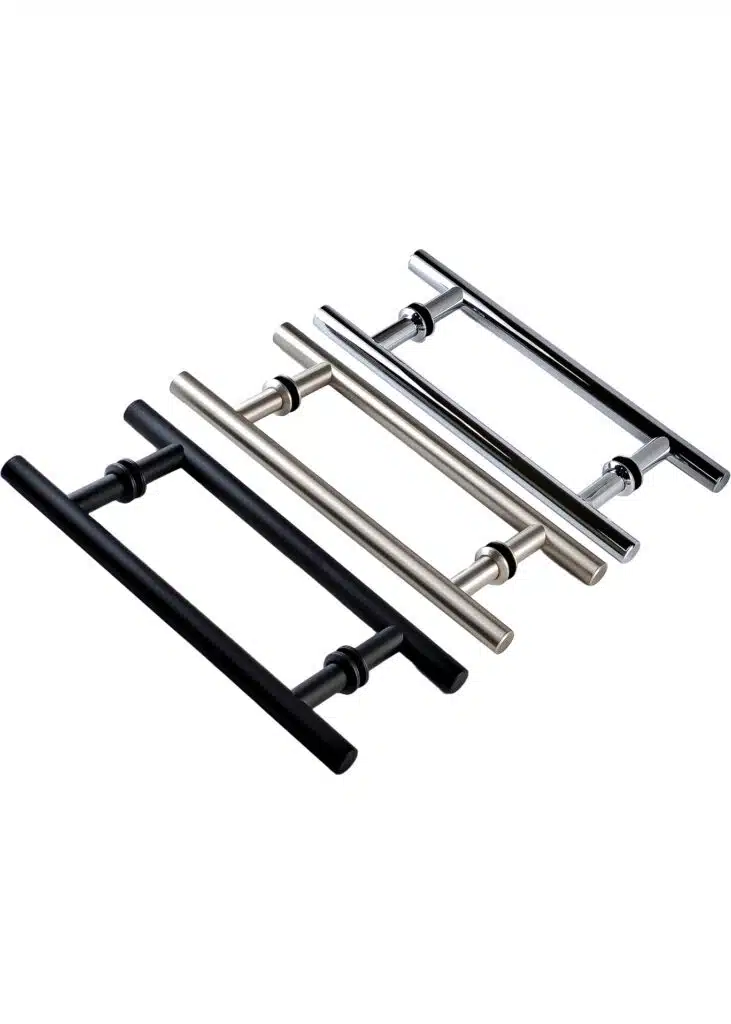
Common specialty finishes people ask for:
- Oil Rubbed Bronze
- Brushed Bronze
- Satin Brass
- Polished Nickel
(Plus other “specialty” finishes depending on manufacturer availability.)
Two real-world notes that matter:
- Not every finish is available for every system. Example: some premium slider configurations list Oil Rubbed Bronze as not available.
- True “specialty colors” are a different bucket. If you’re asking for something outside the usual families (custom tones, limited runs), it’s often call-for-pricing and depends on what manufacturers can actually supply at the time.
Your add-ons: the “small stuff” that can add up fast
A frameless shower can be super clean and simple… until you start adding the extras. None of these are outrageous on their own, but they stack quickly because they’re real hardware, real labor, and sometimes extra planning.
Here are the most common add-ons that influence your price in 2026:
Towel bars (mounted to the glass)
A towel bar looks simple, but it usually means:
- upgraded handle/towel bar hardware
- precise placement so it’s comfortable to reach and doesn’t interfere with the door swing
- additional holes or mounting points depending on the style
Robe hooks and accessory hooks
Same idea. Small item, but it still requires proper placement and compatible mounting hardware.
Handle upgrades (ladder pulls, combo handles, inside pulls, custom lengths)
This is a big one. A basic handle is one thing. A larger pull, a ladder-style handle, or a special combo handle can move cost because it’s a different part altogether.
Header/support decisions (when needed for stability)
Some layouts benefit from (or require) extra support depending on size, configuration, and wall conditions. That can add parts and time, even if it doesn’t change the “look” much.
Notches, cutouts, and special glass work to accommodate the design
This one sneaks up on people. If the glass needs to be notched around a bench cap, a pony wall, a niche return, or odd tile geometry, it can add complexity in fabrication and install.
The takeaway
If you’re trying to stay efficient on budget, keep the core unit simple first, then add extras intentionally. If you really want the towel bar / ladder pull / matching hook set, totally fine. Just know those accessories aren’t just “a little add-on,” they often touch ordering, fabrication, and install steps.
Next section: logistics and site conditions which is the “invisible” factor that can explain why two identical showers can still price differently.
Your jobsite and logistics: the “invisible” factor that can change the price
Two showers can be the same design, same glass, same hardware… and still price differently because of what it takes to actually get the glass in, set it safely, and finish clean.
Frameless glass is heavy, fragile, and installed in tight spaces on finished surfaces. So anything that adds time, coordination, or risk can add cost.
Here are the most common jobsite situations that influence your price in 2026:
Apartments and condos
These jobs can be totally smooth, or they can be a project on their own. Pricing can change when you have:
- reserved parking rules or no close parking
- elevator scheduling (or no elevator)
- limited delivery windows
- COI requirements, security check-ins, or on-site supervision rules
- long walks from parking to unit
Stairs, long carries, tight access
If installers have to move large panels through narrow hallways, up stairs, around tight turns, or through delicate finished areas, it often takes:
- extra manpower
- more time
- more protection and prep
Out-of-plumb walls and uneven curbs (super common in real life)
Bathrooms are rarely perfect. When walls lean, curbs slope, tile has lippage, or corners aren’t square, it can mean:
- more time measuring and planning
- more adjustment and fitting during install
- sometimes design tweaks to make everything look straight even if the room isn’t
Working around finished surfaces
New tile, fresh paint, custom stone, heated floors… all doable, but it increases the need for careful protection, slower handling, and clean execution.
Scheduling and special circumstances
Some installs require more coordination:
- construction sites vs lived-in homes
- restricted work hours
- multiple trips if the jobsite isn’t ready when scheduled
- owner/GC coordination on site readiness
The bottom line
If your bathroom is easy access and fairly square, installs tend to be more efficient. If it’s a condo with rules, tight access, stairs, or tricky tile conditions, the labor reality changes, and the quote usually reflects that.
Next section: how to get a fast, accurate quote for your shower without a bunch of back-and-forth.
How to get the most accurate quote for your shower (fast)
The fastest way to get a tight, reliable quote is to give enough info up front so we’re not guessing. You don’t need perfect measurements. You just need the basics that determine layout, glass, hardware, and logistics.
Here’s what to send:
1) A few clear photos
- One photo straight-on of the shower opening
- One wide photo showing the whole shower area (walls, curb, bench, niche if you have one)
- A photo of the shower head/valve wall (helps with door swing and clearance)
2) Rough opening dimensions
- Width of the opening (or widths if it’s a corner)
- The height you want the glass to go to
- If you don’t have a tape handy, even “about 60 inches wide” is enough to start the conversation
3) The style you want
- Door-only, door + panel, corner, neo-angle, slider, etc.
- If you’re unsure, tell us what you’re trying to solve: “tight bathroom, need a slider” or “want the most open look possible”
4) Your glass preference
- Standard clear vs ultra-clear (low-iron)
- Any privacy needs
- If you want grid-style glass or digital ceramic printing, mention it early
5) Hardware finish + any add-ons
- Finish (chrome, brushed nickel, matte black, satin brass, etc.)
- Towel bar, robe hooks, handle upgrades, inside pull, anything you already know you want
6) Any logistics notes
- Condo/apartment rules, elevator scheduling, COI requirements
- Stairs, long carry from parking, tight access
- Construction site vs lived-in home timing
If you’re in doubt, the easiest path is to schedule a Measure Tech with Affordable Frameless.
They’ll come out, review your project, take precise measurements, and get you to a firm quote. They can also walk you through options on the spot, answer questions about layout, glass, hardware finishes, and help you avoid expensive “wish-I-knew-that” decisions before anything gets ordered.

Wrap-up: what your price is really paying for (and how to get the best value)
By now the pattern should be pretty clear: frameless shower pricing in 2026 isn’t mysterious. It’s mainly driven by a few choices you control.
Your quote is basically a combination of:
- Design: how many pieces of glass and how complex the layout is
- Size: how much glass you’re building and how heavy it is to handle/install
- Glass options: clear vs ultra-clear, privacy, printed designs
- Hardware: finish, system type (especially sliders), and add-ons
- Install reality: access, condo rules, and how “square” the shower actually is
If you want the best value, focus on these moves:
- Keep the layout efficient unless you truly need a more complex design
- Spend where you’ll feel it every day: ultra-clear glass (if your tile is light), a finish you love, and a coating if maintenance is a pain
- Be careful with “extras” that stack cost without changing function much
- Call out logistics early so there are no surprises later
At the end of the day, a good frameless install should feel simple when you’re using it: smooth door swing, tight gaps, clean lines, and glass that stays looking great.
If you want, send a few photos and your best guess on size and style. Or if you’d rather not guess, schedule a Measure Tech with Affordable Frameless and we’ll get you a firm quote with clear options and zero mystery.

HELPING TO IMPROVE SPACES
Affordable Frameless Shower Doors team of professionals brings decades of construction and home remodel experience to you living spaces. Attention to detail is vital for shower glass and we pride our selves on consistent and professional fabrication and install every time.
