
We Spent Decades Making Glass Clearer. Now We Want It Blurry Again.
There is something deeply human about spending decades solving a problem, finally solving it, and then immediately deciding we preferred the problem.
Take shower glass.
For years, the goal was clarity. Cleaner glass. Fewer frames. Less visual obstruction. Eventually we got to low-iron glass, which exists largely because ordinary glass has the audacity to look slightly green around the edges. Apparently this was unacceptable.
So we removed the frames. We reduced the iron. We polished everything. We created large sheets of nearly invisible glass so you could stand in your bathroom and admire every square inch of tile without anything getting in the way.
Mission accomplished.
And now we are putting grooves back into the glass.
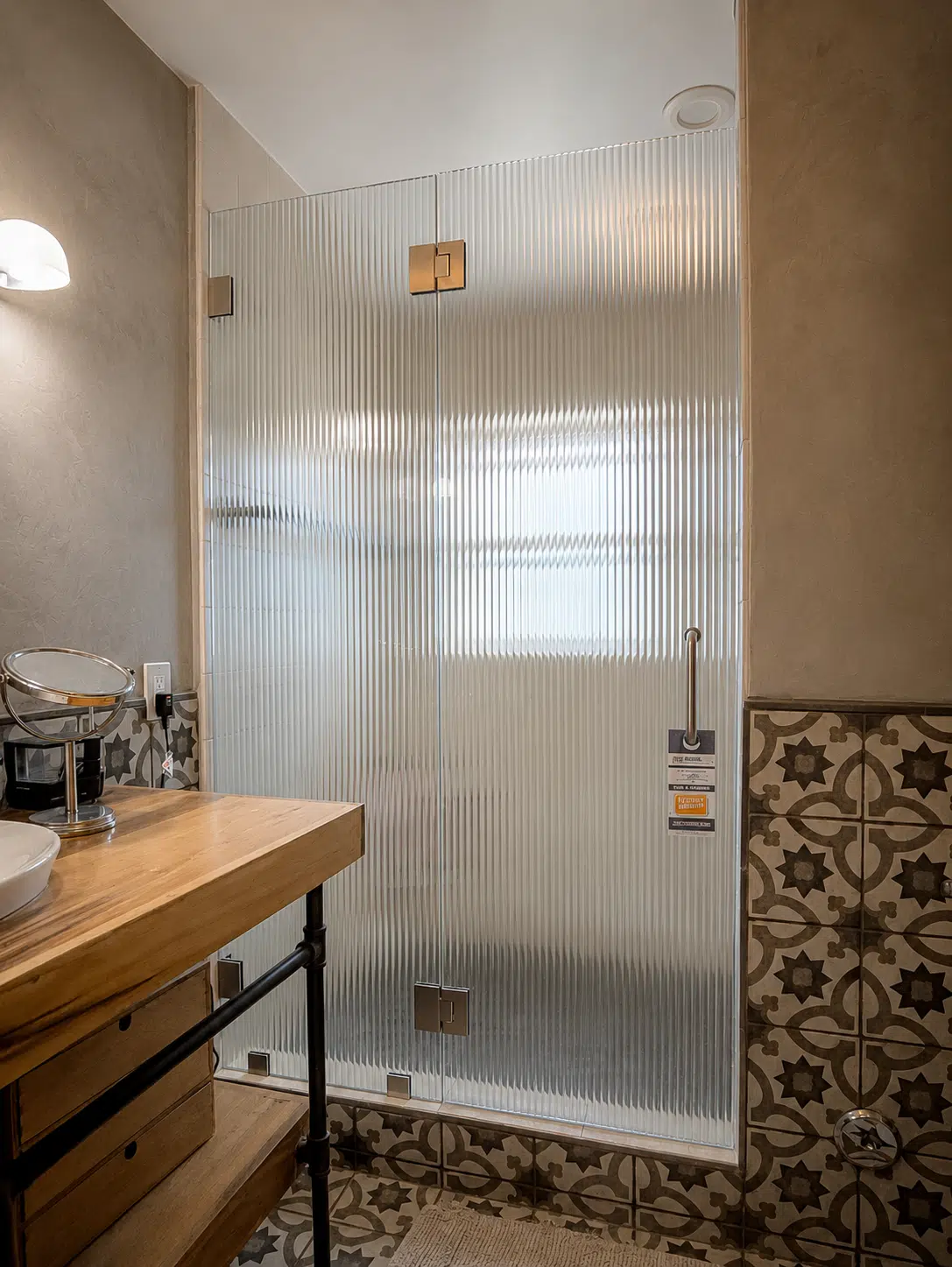
Reeded glass, sometimes called fluted glass, has suddenly started showing up everywhere. Shower doors, room dividers, cabinet fronts, restaurant partitions, fancy offices, homes owned by people who seem to know what a boucle chair is.
At first glance it feels like another design trend someone invented six months ago, gave a sophisticated name, and then convinced the rest of us we had somehow been living incorrectly without it.
Except that is not what happened.
Reeded glass is old.
Really old.
Architects and designers have been using versions of textured and ribbed glass for generations because it does something surprisingly useful: it lets light through while making whatever is on the other side considerably less obvious.
Which, when you think about it, is a pretty useful characteristic for something surrounding a shower.
So yes, after years of making shower glass disappear, we have apparently decided we would like to see the glass again.
And in this particular case, we may actually be onto something.

So What Exactly Is Reeded Glass?
Reeded glass is glass with a series of narrow vertical ribs or grooves running across its surface.
That is basically it.
No mysterious technology. No tiny reeds embedded in the glass. Nobody is weaving it by hand in a small village in Italy.
It is textured glass.
The vertical pattern bends and distorts the view through the panel. Light still passes through, but details on the other side become blurred and broken up.
Imagine looking through a perfectly clear window.
Now imagine someone gently stretched everything behind that window into a series of vertical waves.
That is roughly what reeded glass does.
You will also hear the term fluted glass, and in residential design the two names are often used almost interchangeably. There can be differences in the depth, width, and shape of the ribs depending on the specific glass pattern, but most homeowners asking for either one are looking for the same general thing:
Vertical texture. More privacy. Still plenty of light.
That combination is the reason it works so well in bathrooms.
Clear glass gives you maximum openness, but absolutely no mystery whatsoever.
Frosted glass gives you privacy, but it can sometimes make the shower feel visually heavier.
Reeded glass lands somewhere in between.
You still get the light and openness of glass, but without feeling like your shower has been placed in the middle of an aquarium exhibit.
And unlike a film or surface-applied pattern, the texture is part of the glass itself. It gives the panel depth and changes depending on the light, angle, tile, and hardware around it.
Which means the glass stops being something that simply keeps water inside the shower.
It becomes part of the architecture.

This Stuff Is Older Than Your Bathroom Designer Thinks
One of the funny things about design trends is that very few of them are actually new.
Give something enough time, change the name slightly, photograph it in a beautifully lit house, and suddenly everyone acts like we just discovered it.
Reeded glass has been around for generations.
Long before anyone was posting bathroom remodels on Instagram, textured glass was being used in doors, windows, office partitions, cabinets, storefronts and all sorts of architectural applications where people wanted light to pass through without giving everyone on the other side a perfectly clear view.
It solved a very practical problem.
You could separate two spaces without making either one feel dark.
That is a pretty elegant trick.
It also explains why you still see old buildings with ribbed or patterned glass in interior doors and partitions. Sometimes the glass was there for privacy. Sometimes it was there to diffuse light. Sometimes it was simply more interesting than staring through another perfectly flat sheet of glass.
Eventually, as architecture moved toward cleaner lines and larger expanses of clear glass, a lot of that texture disappeared.
Clear became modern.
Texture became old fashioned.
Then, as tends to happen, we apparently looked around at all of our perfectly clean, perfectly white, perfectly flat modern interiors and realized we had accidentally designed a very expensive medical office.
So texture started coming back.
Wood grain. Handmade tile. Natural stone. Plaster. Ribbed cabinetry.
And, inevitably, reeded glass.
The interesting part is that it does not feel particularly nostalgic when you use it today. Put reeded glass next to matte black hardware, brushed brass, large-format tile or a clean frameless enclosure and it suddenly looks completely contemporary.
Same basic idea.
Different century.
Why It Works So Well in a Bathroom
Bathrooms have a strange design problem.
There are a lot of hard surfaces.
Tile. Stone. Glass. Metal. Porcelain.
Everything is durable, waterproof and easy to clean, which is exactly what you want in a bathroom.
Unfortunately, if you are not careful, all those smooth surfaces can also make the room feel a little sterile.
Reeded glass gives you a way to add texture without actually adding another material.
You are still using glass. You are still getting the openness of a frameless enclosure. You are still allowing light to move through the room.
But now the glass has some visual weight.
Light catches the ribs differently throughout the day. Tile behind the glass gets distorted. Hardware stands out against it. The shower becomes a little less invisible and a little more intentional.
And this works particularly well because reeded glass does not demand a specific design style.
Pair it with matte black hardware and it can feel architectural and modern.
Put it next to brushed gold or brass and it can lean warmer and a little more traditional.
Use it with travertine, marble, warm stone or wood tones and it softens the room.
Use it with white tile and clean lines and it adds just enough texture to keep the bathroom from looking like someplace you are about to have your blood pressure checked.
It can also solve a problem that clear glass cannot.
Sometimes you spend a small fortune on beautiful shower tile and absolutely want to see all of it.
Other times the view through the shower is mostly shampoo bottles, a drain, and whatever mysterious collection of products your family has accumulated in the corner.
Maybe that does not need to become the focal point of the bathroom.
Reeded glass lets the shower remain open and bright while taking some of the visual clutter out of the equation.
That is probably the biggest reason the look works.
It is decorative without being busy.
It gives you privacy without building a wall.
And it makes the glass itself interesting without turning the shower into something you are going to have to explain to the next homeowner.

The Privacy Thing
Let’s be honest.
A shower is one of those places where the phrase “open concept” has limits.
For years, clear frameless glass was sold almost entirely on openness. And visually, that makes perfect sense. Clear glass makes a bathroom feel larger, shows off the tile, lets light move through the room, and generally does everything designers want glass to do.
It also allows anyone standing in the bathroom to see absolutely everything happening inside the shower.
Every. Single. Thing.
For some people, that is fine.
For others, particularly in a shared primary bathroom, this can eventually feel less like luxury and more like living in a very tasteful terrarium.
This is where reeded glass becomes useful.
The vertical ribs distort whatever is behind the glass. You can still tell that a person is there. This is not an invisibility cloak, and nobody should be making purchasing decisions under that impression.
But details get broken up considerably.
Faces blur. Body lines distort. Shampoo bottles become vaguely colorful vertical objects. The whole scene becomes significantly less informative.
And the important part is that you get that privacy without sacrificing most of the light.
That is the advantage over something more opaque.
Frosted glass can provide considerably more privacy, but it also becomes a stronger visual object in the room. Instead of looking through the shower, you are looking at the shower enclosure.
Reeded glass splits the difference.
It gives you separation without completely closing things off.
This is especially useful in larger primary bathrooms where two people may actually be using the room at the same time.
Because despite what bathroom advertisements would have us believe, the average married couple is not spending every morning silently admiring each other through pristine sheets of low-iron glass while sunlight gently pours through a nearby window.
Someone is brushing their teeth.
Someone is looking for a towel.
Someone has just realized there is no shampoo.
Someone else would like just a little privacy while all of this is happening.
Reeded glass handles that surprisingly well.
Reeded vs. Clear vs. Frosted vs. Low-Iron
At some point in the process of buying a shower door, you will discover that “glass” is no longer a sufficiently specific word.
You will be asked what kind.
- Clear.
- Low-iron.
- Frosted.
- Reeded.
And suddenly a material mankind has been using for roughly five thousand years requires a consultation.
So here is the simple version.
Clear Glass
Clear glass is the standard.
It is clean, simple, and works with almost everything.
If you have beautiful tile and want to see it, clear glass is probably the obvious choice. It creates the least visual interruption and keeps the bathroom feeling as open as possible.
Its downside is equally obvious.
It hides nothing.
Water spots, shampoo bottles, towels hanging where they should not be hanging, the person showering.
Clear glass believes strongly in transparency.
Sometimes a little too strongly.

Low-Iron Glass
Low-iron glass is what happens when clear glass is not clear enough.
Standard glass contains iron, which gives it a slight green tint, particularly around the edges and in thicker panels.
Most people live perfectly normal, productive lives without ever being troubled by this fact.
Then someone points it out.
After that, you will see it forever.
Low-iron glass removes much of that green cast and gives you a noticeably cleaner view through the glass, especially against white marble, white tile and other light finishes.
If your goal is for the glass to disappear as much as possible, this is usually the direction you go.
It is essentially clear glass with an advanced degree.

Frosted Glass
Frosted glass goes the other direction.
Instead of trying to make the glass disappear, it deliberately obscures the view.
If privacy is the main goal, frosted glass does a very good job.
It still allows light through, but you lose much more visual detail than you do with reeded glass.
The tradeoff is that it feels more solid.
There is no mistaking the shower enclosure for open space. The glass becomes a visible wall of diffused light.
That can look great in the right bathroom.
But it is a different effect.
Reeded Glass

Reeded glass lives somewhere in the middle.
It does not disappear like clear or low-iron glass.
It does not obscure everything like heavily frosted glass.
Instead, it distorts.
You get light.
You get texture.
You get a reasonable amount of privacy.
And you still retain some sense of depth through the enclosure.
Which one is better?
That depends entirely on what problem you are trying to solve.
If you want your shower tile to be the star, use clear or low-iron.
If privacy is everything, frosted may make more sense.
If you want privacy but still want the bathroom to feel open, reeded glass starts becoming very interesting.
There is no universal “best” glass.
There is only the glass that makes the most sense for the bathroom you actually have.
Which is admittedly less exciting than declaring one of them the undisputed champion and forcing the others into some kind of glass-based tournament.
But probably more useful.
Where Reeded Glass Works Best
Reeded glass can technically work in a lot of shower layouts, but that does not mean every shower needs to become a monument to vertical texture.
Restraint is still a thing.
One of the best applications is a single fixed splash panel.
You get one large, uninterrupted piece of textured glass, which lets the pattern actually do something visually. There are no hinges, handles, or multiple seams chopping it up. It just sits there looking architectural and quietly preventing water from reaching the rest of the bathroom.
A noble calling.
It also works extremely well in door-and-panel inline showers, especially when you want the shower to feel like a more deliberate part of the room instead of something that simply occupies the back corner.
Larger walk-in showers are another natural fit.
The more glass you have, the more interesting the texture becomes. Light moves through it differently depending on the time of day, and tile or stone behind the panel gets stretched and distorted into vertical bands.
This can be especially effective if the bathroom itself is fairly simple.
If you already have dramatic marble, patterned tile, three different metals, a chandelier, a freestanding tub and a sink that looks like it was carved from a meteorite, perhaps the glass does not also need to enter the conversation.
But in a clean bathroom with restrained finishes, reeded glass can add exactly the right amount of visual interest.
It also makes practical sense when the shower is positioned prominently in the room.
Maybe the shower is directly across from the vanity.
Maybe it is visible from the bathroom entrance.
Maybe the toilet sits somewhere behind it and the architect apparently decided privacy was a challenge for future generations to solve.
A textured panel can soften all of that without building another wall and cutting off the light.
And no, you do not necessarily have to texture every piece of glass in the enclosure.
Depending on the design and the glass available, mixing a textured panel with clear glass can sometimes create a really interesting result. One piece provides the architectural texture and privacy while the rest of the enclosure stays visually light.
The important thing is that the choice should look intentional.
Reeded glass works best when it solves a problem or adds something useful to the room.
Not simply because someone on Instagram has informed us that vertical lines are currently important.
Which Side Do the Grooves Go On?
This sounds like an incredibly boring question.
It is also exactly the kind of boring question that becomes surprisingly important about three days after installation.
Reeded glass is not always identical on both sides.
Depending on the specific glass pattern, one face may be relatively smooth while the other carries more of the ribbed texture.
That matters in a shower for one very obvious reason:
- Water.
- Soap.
- Minerals.
- Conditioner.
Whatever that blue stuff is your teenager has been using for six months.
All of it eventually finds its way onto the glass.
A deeply textured surface gives those things more little valleys and grooves to settle into than perfectly smooth glass does. And while this is hardly a maintenance catastrophe, it is worth thinking about before you decide which surface spends its life getting sprayed with Southern California tap water.
When possible, the smoother surface is generally the one you would prefer facing the wet side of the shower.
That makes everyday cleaning simpler and gives a squeegee a fighting chance of actually doing its job.
The textured side can then face outward, where it creates the visual effect without spending every morning being pressure-washed with shampoo.
But this is something that should be confirmed with the specific reeded glass being used, because patterns and manufacturers vary.
This is also why we do not love the idea of choosing specialty glass from one tiny photograph on a phone.
Texture is weird.
The same glass can look subtle when viewed straight on, dramatic from an angle, nearly clear in one kind of light and much more private in another.
You really want to see the actual pattern.
Look through it.
Stand beside it.
See how deep the ribs are.
Decide whether you like the way it distorts whatever is behind it.
Because once we temper a custom piece of shower glass to fit your bathroom, we cannot bring it back to the shop and ask it to be slightly less interesting.
Glass is stubborn that way.

Is Reeded Glass Harder to Clean?
A little.
There. We said it.
Any time you add texture to a surface, you are giving water, soap and minerals more places to hang around than they have on perfectly smooth glass.
This does not mean owning reeded glass requires specialized equipment, a chemistry degree, or a small maintenance staff.
It just means the orientation of the glass matters, and you should have realistic expectations.
If the smoother side of the glass can face the shower interior, everyday cleaning is pretty straightforward. A squeegee still works. Normal shower-glass cleaners still work. You are basically caring for a smooth piece of glass.
If the textured side is exposed to the wet side, you will probably spend a little more time cleaning the grooves.
And here in Southern California, there is another participant in this discussion:
hard water.
Hard water does not care how beautiful your bathroom is.
It does not care what the glass cost.
It does not care that you spent six weeks choosing between brushed gold and satin brass.
If water repeatedly dries on glass, minerals get left behind.
Reeded glass does have one strange advantage here. Because the surface already distorts reflections and views, minor spotting can sometimes be less visually obvious than it is on a giant pristine sheet of clear glass.
Clear glass is ruthless.
One water spot appears and suddenly that is the only thing you can see.
Reeded glass has a little more going on visually.
Still, the best plan is the same plan we recommend for basically every shower: do not let years of mineral deposits build up and then declare war on them one Saturday afternoon.
A quick squeegee and reasonable cleaning routine will beat an archaeological excavation every time.
Protective coatings may also be an option depending on the particular glass and which surface is being treated. That is something we would confirm with the specific material before fabrication rather than simply assuming every textured glass behaves exactly the same way.
Because it doesn’t.
Glass manufacturers have apparently decided we needed more variables.
Does Reeded Glass Cost More?
Yes.
Reeded glass is a specialty glass, so it generally costs more than standard clear.
But this is where internet articles tend to become wonderfully useless.
You will inevitably find someone telling you that a reeded glass shower costs exactly some oddly specific amount, as though every shower in America is 60 inches wide, 78 inches tall and installed in the same perfectly square bathroom.
That is not how custom shower glass works.
- The cost depends on the actual enclosure.
- How much glass are we using?
- Is it one fixed panel or several pieces?
- How tall is it?
- How wide?
- Is there a door?
- Are there notches?
- What hardware are we using?
Is the glass readily available in the thickness and pattern needed for the project?
A single reeded splash panel is obviously a very different project from a three-piece custom enclosure with a swinging door and specialty hardware.
The useful way to think about it is this:
Standard clear glass is the baseline. Reeded glass is an upgrade.
How much of an upgrade depends largely on how much specialty glass the shower needs and how complicated the enclosure is.
For some bathrooms, that means the design upgrade is relatively modest.
For others, particularly large multi-panel showers, the difference becomes more meaningful.
This is also one of those decisions where we think seeing the actual glass first matters.
There is very little point paying extra for a specialty pattern because it is currently fashionable if you look at the sample and think it resembles the privacy glass in your dentist’s office.
You are going to live with it.
You should actually like it.
Is Reeded Glass Going to Look Dated in Five Years?
Possibly.
There is your wonderfully definitive answer.
Anyone who tells you with certainty that a current design trend is “timeless” is making a prediction about the tastes of millions of people who have not even remodeled their bathrooms yet.
We cannot do that.
We have all collectively made design decisions that seemed perfectly reasonable at the time.
Avocado-green appliances happened.
Carpeted bathrooms happened.
For a period of human history, people voluntarily installed glass blocks everywhere.
We should remain humble.
That said, reeded glass has one important thing going for it:
it was around long before 2026.
This is not some new material invented specifically to satisfy an Instagram trend.
Architects have used ribbed and textured glass for a very long time because the basic idea works. It provides privacy, transmits light and adds visual texture without needing color or ornament.
That gives it a better chance of aging gracefully than something dependent on one very specific moment in design.
It is also relatively restrained.
There are no giant patterns.
No inspirational phrases permanently etched across the shower.
No complicated collection of colors that need to match the rest of the bathroom for the next twenty years.
It is just vertical texture in glass.
Could clear glass become the dominant look again?
Of course.
It never really stopped being the dominant look.
But that is not necessarily the right question.
The better question is whether you actually like reeded glass in your bathroom.
Because if you love the way it looks, appreciate the extra privacy and think it makes the room more interesting, you are probably not going to wake up in 2029 furious that the vertical lines are no longer featured heavily on Pinterest.
And if you already dislike it today, absolutely do not install it because somebody has declared it the glass of 2026.
That is how carpeted bathrooms happen.
So, After All That…
We spent years making shower glass clearer.
Then we removed the frames.
Then we developed low-iron glass because regular clear glass apparently still contained several molecules too much personality.
And now, after finally creating glass that can practically disappear, we have decided we would like to see it again.
Reeded glass takes something that has traditionally been designed to vanish into the bathroom and turns it into an architectural element.
It gives you texture without adding another material.
Privacy without building another wall.
Light without putting everything happening inside the shower on public display.
And it manages to look contemporary while using an idea that has been around for generations.
So yes, the design world has once again gone in a giant circle.
But every once in a while, going in circles brings you back to something that was pretty good in the first place.
If you’re considering reeded or fluted glass for your shower, send Affordable Frameless a few photos of the opening and some rough dimensions.
We’ll tell you whether it works with your layout, show you the available glass options, and help you figure out whether reeded glass is actually right for the bathroom.
Because trends are useful.
But liking your own bathroom is considerably more important.

HELPING TO IMPROVE SPACES
Affordable Frameless Shower Doors team of professionals brings decades of construction and home remodel experience to you living spaces. Attention to detail is vital for shower glass and we pride our selves on consistent and professional fabrication and install every time.
